
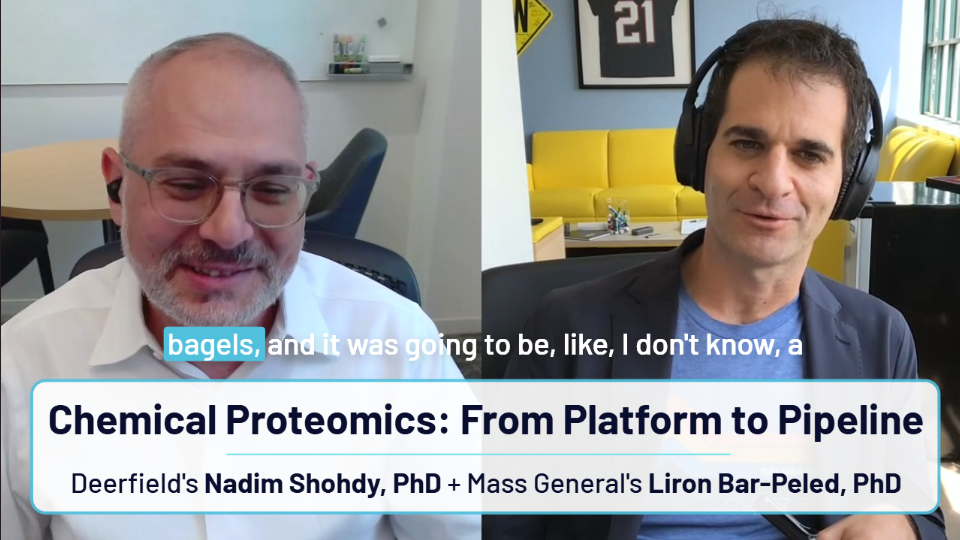
3DC’s Chief Operating Officer Nadim Shohdy, PhD, sat down with Harvard & Mass General Brigham investigator Liron Bar-Peled, PhD, to discuss a question reshaping drug discovery in oncology: what does "undruggable" mean now?
Liron Bar-Peled is the Rullo Family Endowed Chair in Cancer Research and an Associate Professor of Medicine at Harvard Medical School, based at Mass General Brigham Cancer Institute's Krantz Family Center for Cancer Research, where his lab builds chemical proteomic platforms to map the druggable genome in cancer.
From discussion of the recent KRAS breakthrough to Liron’s story behind co-founding Scorpion Therapeutics, Liron and Nadim discuss how to turn an unbiased map of the proteome into a coherent pipeline and debate what AI can and can't tell you about a binding site. Plus, hear what Liron learned about teams, timelines, and killing programs along the way.
✨ Key Insights ✨
💉 "Undruggable" really just means nobody has looked hard enough
For decades, small molecules could only reliably target proteins like kinases, with an obvious deep pocket; slipperier targets got shelved. Today, Liron’s approach to chemical proteomics inverts the question: rather than guessing which proteins have a pocket, Liron and team apply tens of thousands of reactive small molecules across the entire proteome at once and ask experimentally where a drug-like molecule can bind.
In Liron's words: "It's really an unbiased map of where drugs can bind. And the cool thing is that it keeps turning up sites on proteins that everyone else has given up on."
🔬 KRAS has become the proof
Cracking the most famous oncogene in cancer resisted forty years of effort. What finally made the difference was a chemical biology insight: the G12C mutation creates a cysteine reactive enough to form a covalent bond. It’s the basis for how drugs like sotorasib and adagrasib work, and it changed Liron’s thinking about the nature of a binding site.
🗺 The map runs in both directions
Sometimes Liron’s lab starts from a target it already cares about and asks whether any site on it can be grabbed. But the harder and more interesting approach is unbiased: map the whole proteome and let the data nominate proteins nobody had on their list.
As Liron puts it, everyone in cancer is working from the same set of genes, so differentiation has to come from somewhere.
📍 A platform is only as good as the pipeline it delivers
Liron co-founded Scorpion Therapeutics on his lab's approach to chemical proteomics, but the company deliberately chose to advance two more mature programs alongside its work on harder targets. Investors and patients, Liron notes, care about molecules you’ve already made more than the ones a platform might someday yield.
His hardest-won lesson: define a problem as precisely as possible before falling in love with the science.
🤖 Where AI helps… and where it doesn't
Liron is enthusiastic about AI, but draws a line between the technology’s ability to predict and its ability to measure. Whether a molecule can bind a protein and disrupt its function inside a living tumor is experimental and context-dependent, but today's models are trained largely on purified proteins, which behave very differently than proteins inside a cell, which are surrounded by everything else.
He frames it like this: AI may be able to carry a program from one to ten, or ten to a hundred. But the zero-to-one - learning that a site is ligandable at all - still takes some pretty sophisticated experiments.
Deerfield's collaboration with Harvard, Lab1636, is designed to pair scientific rigor with creative funding structures that aim to carry early discoveries across the translational gap and into the hands of patients.